POST 16 EDUCATION REFORMS: INTRODUCING ‘V LEVELS’
In October, the UK Government announced a range of changes for post-16 education. What grabbed headlines were details of the proposed new ‘V Levels’, which will be “new vocational qualifications tied to rigorous and real-world job standard”. V Levels will form part of a new educational goal for two-thirds of young people to participate in higher-level learning – academic, technical, or apprenticeships – by age 25.
TUITION FEES TO RISE IN LINE WITH INFLATION
The Department of Education (DfE) press release included further news, which gained less coverage:
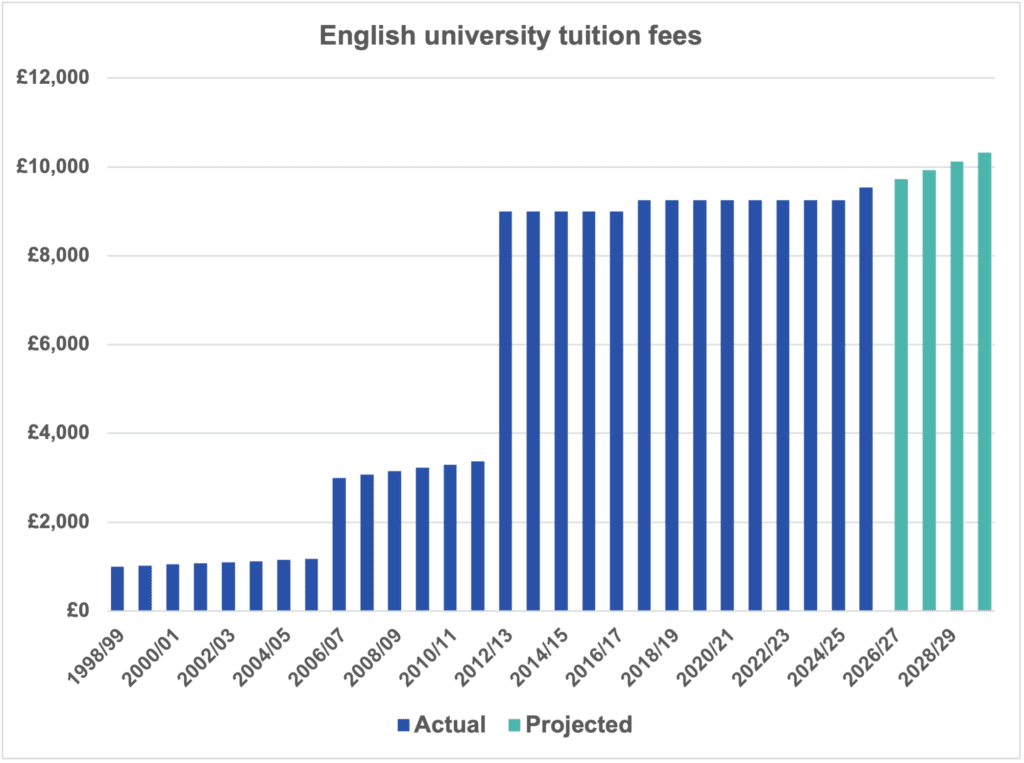
• University tuition fees in England will rise in line with forecast (unspecified) inflation for the next two academic years.
• Thereafter, subject to the introduction of new legislation, future years will see automatic increases in line with inflation.
CROSSING THE £10,000 THRESHOLD BY 2028/29
As the graph above shows, even if the assumed and actual inflation is 2%, then by the 2028/29 academic year, English tuition fees will have crossed the £10,000 threshold – ten times their 1998/99 starting level.
HOW TUITION FEES DIFFER ACROSS THE UK
Tuition fees are a different matter in other parts of the UK – in Scotland, for example, there are no fees for Scottish students attending Scottish universities. However, what England decides on fees plays a major role, both in terms of setting the tone and the level of tuition fees paid by students in Scotland, Wales and Northern Ireland, if they choose a university outside their home country.
KEY FEATURES OF PLAN 5 STUDENT LOANS
The announcement of the new tuition fee escalator comes two years after a major change to the way student loans operate for new undergraduates in England; those who started their course before 2023/24 were unaffected. The latest loan rules – known as Plan 5 – have three important features:
• Repayment is at the rate of 9% of income over £25,000 (frozen until at least 2027), starting in the April after leaving university.
• Interest is charged at the rate of the Retail Price Index (RPI) inflation in March of each year (3.2% for 2025).
• Any loan outstanding at the end of 40 years (or on death) is automatically written off.
Those terms apply to all student loans – both maintenance and tuition fees – so could cover £60,000 of debt for a new graduate. However, before you consider paying up front for your child’s (or grandchild’s) higher education, do take financial advice, as it may not be the most sensible option.