Henson Crisp independent financial advisers in Peterborough and Cambridge
RISK WARNING
The value of the investment and the income from it can fall as well as rise and investors may not get back what they originally invested.

Past performance is not a reliable indicator of future performance. 
RISK WARNING
The value of the investment and the income from it can fall as well as rise and investors may not get back what they originally invested.

Past performance is not a reliable indicator of future performance.
Bricks and mortar are not always a sure-fire winner.

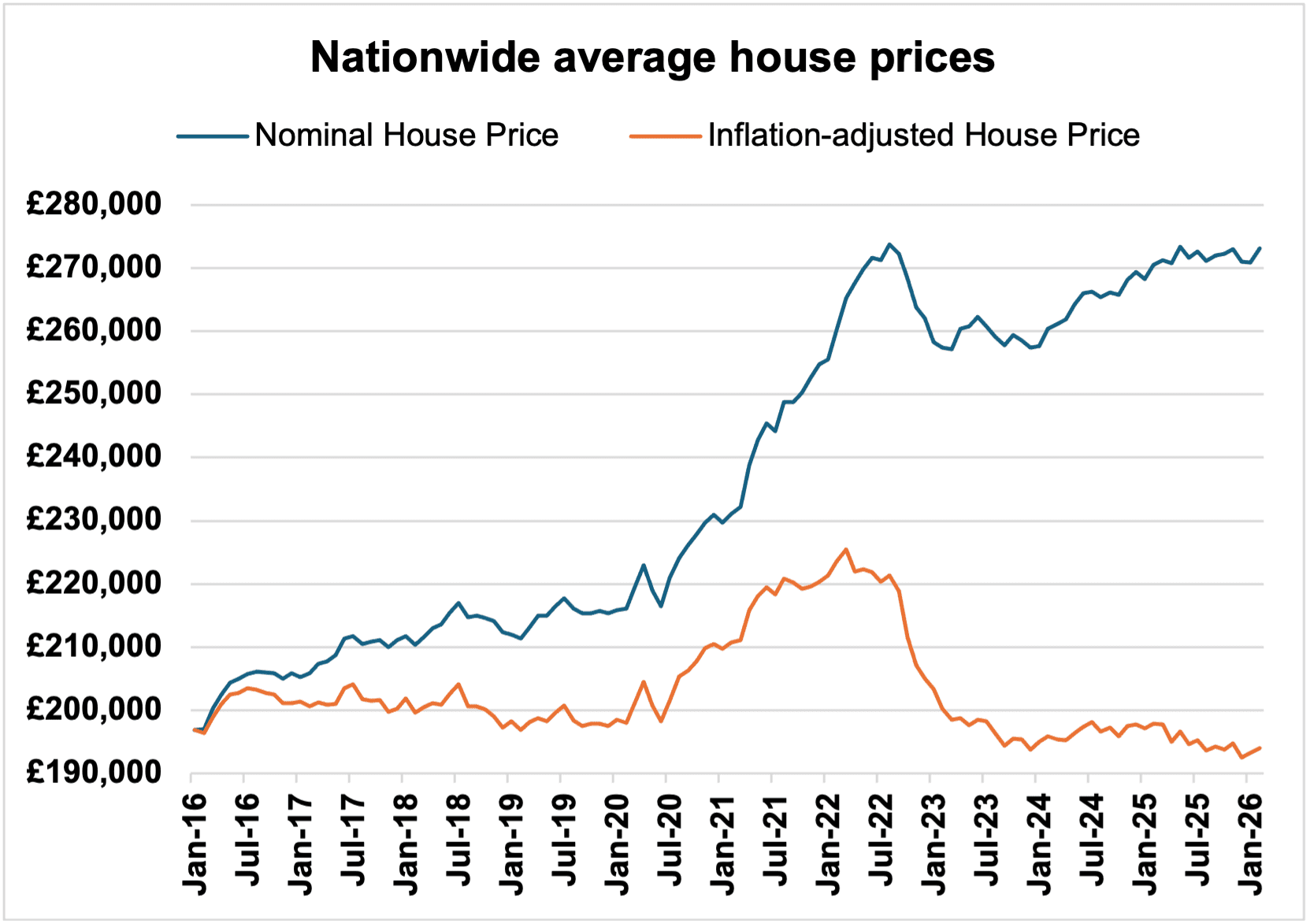
From January 2016 to January 2026, did house prices grow faster than inflation? The answer is in the graph below.
Source: Nationwide average house prices graph showing nominal house price and inflation adjusted house price
Source: Nationwide, ONS

What the data shows about house prices vs inflation

Nationwide Building Society says the average UK house price in January 2016 was £196,829. Ten years later, it had risen to £270,873, a 37.6% increase. Over the same period, the Consumer Prices Index (CPI) increased by 40.2%.

The house price growth has slowed

If the result is not what you expected, it could be because you remember the unexpected boom during and immediately after the Covid-19 pandemic, but forgot the somewhat turgid period for house prices that followed. In the three years from January 2023, the average house price rose by 4.9%, while the CPI added 10.4%.

The impact of interest rates on property

Ironically, some of the recent slowdown in house price growth is linked to general inflation. One factor that put the brake on house prices was the increase in interest rates made by the Bank of England to bring down inflation (which peaked at over 11% in October 2022). Until June 2022, the Bank of England rate was no more than 1%. As anyone facing the imminent expiry of a five-year fixed rate mortgage knows, the Bank’s action on interest rates, now compounded by the Iran war, has made borrowing considerably more expensive than half a decade ago.

Buy-to-let pressures and rental demand

The near flatlining of house prices and, until recently, cuts to mortgage rates did make life marginally easier for first-time homebuyers. That has not been good news for one group of existing property owners: buy-to-let investors. Zoopla, the property website, reported that at the start of the year, average enquiries per rental property were at their lowest level since 2019 and down a fifth on January 2025. Reduced demand has translated into slowing rental growth, which has come down from 7.8% annual growth in January 2025 to 3.1% a year later, according to data from the Office for National Statistics. In England, buy-to-let investors are also facing the implementation of the Renters’ Rights Act, which from 1 May 2026 will put an end to no-fault evictions (‘section 21 orders’). 

Buying and owning your own home generally remains a sensible move, but be wary of treating it as the only investment you need to make.


FREQUENTLY ASKED QUESTIONS

Have UK house prices beaten inflation over the last decade?

No. Between 2016 and 2026, house prices rose by less than inflation as measured by the Consumer Prices Index.

Why did house prices slow after the pandemic?

Higher interest rates, reduced affordability and economic uncertainty combined to slow house price growth after the initial pandemic boom.

How has inflation affected buy to let investors?

Rising costs and slower rental growth have reduced returns, alongside regulatory changes affecting landlords in England.
GET IN TOUCH
Start your journey to financial freedom today.
Personal Finance Society Badge
Consumer Duty Alliance
Financial Vulnerability Charter Badge
Henson Crisp Limited

Telephone: 01733 355120

Email: enquiries@hensoncrisp.com

Henson Crisp Ltd is directly authorised and regulated by the Financial Conduct Authority, financial register number: 469175. Company is registered in England & Wales 06266686; (Registered office: Ground Floor, Bank House, The Lawns, Peterborough, Cambridgeshire, PE3 6AB).

Financial Advice for individuals and businesses
Site Disclaimers

No investment decision should be taken based on the content of this site. Always take full individual advice first.

Henson Crisp Limited cannot be held responsible for the accuracy of the content of external websites.

The information contained within this site is subject to the UK regulatory regime and is therefore targeted primarily at consumers based in the UK.

The Financial Ombudsman Service (FOS) is an agency arbitrating on unresolved complaints between regulated firms and their clients. Full details can be found on its website at www.financial-ombudsman.org.uk.
 © Henson Crisp Ltd. All rights reserved.
linkedin facebook pinterest youtube rss twitter instagram facebook-blank rss-blank linkedin-blank pinterest youtube twitter instagram