Henson Crisp independent financial advisers in Peterborough and Cambridge
RISK WARNING
Tax treatment varies according to individual circumstances and is subject to change.

The Financial Conduct Authority does not regulate tax advice.
Further details have emerged about the potential impact of the ‘mansion tax’ announced in the last Budget.

Rachel Reeves’ first two Budgets have so far featured announcements of tax-raising measures with delayed starting dates. For example, the controversial changes to inheritance tax (IHT) business and agricultural relief emerged in October 2024 but have only just taken effect. Similarly, bringing pensions within the scope of IHT was announced at the same time, but will not commence until 6 April 2027. 

What is the proposed mansion tax?

In her Autumn 2025 Budget, she set out plans for a High Value Council Tax Surcharge (HVCTS – aka ‘mansion tax’) on homes valued at £2 million and above, to start in April 2028. There was little detail about the measure, but a consultation was promised “in the New Year”. So far, nothing has been published by the Treasury, but just before Easter, the Office for Budget Responsibility (OBR) set out its assessment of the new tax’s impact. These included some interesting nuggets:

How the mansion tax could affect property prices

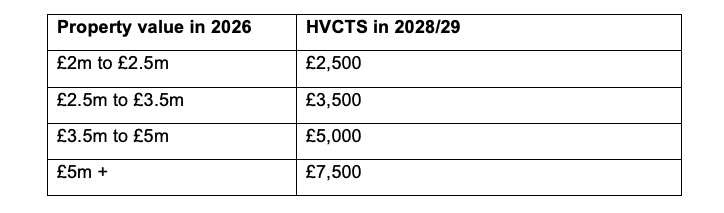
By 2028, the OBR thought the full value of the future HVCTS liability would be reflected in property prices. Although the OBR did not spell out the numbers, what this means in practice is that for every £1,000 of consumer price index (CPI)-linked HVCTS annual charge, the OBR expects a property’s value to drop by about £35,000. For the lowest £2,500 charge covering properties valued at £2–2.5 million, their value would drop by about £87,500, according to OBR theory.

Why high-value homes may face price pressure

The OBR forecasts that there will be a bunching of prices just below each threshold, which would further lower prices for properties that would otherwise be just above a threshold. The OBR is on solid ground with this assumption, as it is exactly what happened when a single stamp duty rate was based on a house’s price.
Table showing the mansion tax and property prices

Appeals could be more common than expected

One-in-five property owners (who are liable to the tax, rather than the occupiers) are expected to lodge an appeal, with a 40% success rate.

Perhaps the most telling point is that the new tax would initially raise only £400 million in 2028/29, hardly even a rounding error in Treasury accounting terms. Almost the same sum could have been generated by raising the standard rate of VAT from 20% to 20.04%, although the politics would have been much trickier.

We’ll have to wait and see if the OBR’s expectations pan out.

FREQUENTLY ASKED QUESTIONS

What is the proposed mansion tax?

The proposed “mansion tax” is a new High Value Council Tax Surcharge (HVCTS) announced in the Autumn 2025 Budget. It would apply to homes in England valued at £2 million or more, with annual charges increasing in bands depending on the property’s value.

When could the mansion tax start?

The government has said the surcharge is due to begin in April 2028. However, further detail is still awaited, as a formal consultation was promised but has not yet been published.

How might the mansion tax affect property prices?

The Office for Budget Responsibility (OBR) expects the future cost of the surcharge to be reflected in property values before it begins. In practice, that could mean downward pressure on prices for homes above £2 million, particularly those just over a tax threshold, as buyers may factor the extra annual cost into what they are willing to pay.
RISK WARNING
Tax treatment varies according to individual circumstances and is subject to change.

The Financial Conduct Authority does not regulate tax advice.
GET IN TOUCH
Start your journey to financial freedom today.
Personal Finance Society Badge
Consumer Duty Alliance
Financial Vulnerability Charter Badge
Henson Crisp Limited

Telephone: 01733 355120

Email: enquiries@hensoncrisp.com

Henson Crisp Ltd is directly authorised and regulated by the Financial Conduct Authority, financial register number: 469175. Company is registered in England & Wales 06266686; (Registered office: Ground Floor, Bank House, The Lawns, Peterborough, Cambridgeshire, PE3 6AB).

Financial Advice for individuals and businesses
Site Disclaimers

No investment decision should be taken based on the content of this site. Always take full individual advice first.

Henson Crisp Limited cannot be held responsible for the accuracy of the content of external websites.

The information contained within this site is subject to the UK regulatory regime and is therefore targeted primarily at consumers based in the UK.

The Financial Ombudsman Service (FOS) is an agency arbitrating on unresolved complaints between regulated firms and their clients. Full details can be found on its website at www.financial-ombudsman.org.uk.
 © Henson Crisp Ltd. All rights reserved.
linkedin facebook pinterest youtube rss twitter instagram facebook-blank rss-blank linkedin-blank pinterest youtube twitter instagram