How UK inflation moved in 2025
Inflation has been on something of a rollercoaster in recent years, buffeted by the COVID-19 pandemic and the Ukraine war, among other factors. The Consumer Prices Index (CPI) annual inflation reading for December 2025 was 3.4%, higher than the 2.5% of December 2024, but lower than the 4.0% of December 2023 and the 10.5% of December 2022.
Why the cost of living remains centre stage
The cost of living has been in the headlines on both sides of the Atlantic, although the preferred term in the US is ‘affordability’. In the UK, the Prime Minister has repeatedly stated: “Every minute that we're not talking about the cost of living is a wasted minute,” promising that, “This year I am going to tackle the cost of living.”
Inflation and the Bank of England's 2% targets
2025’s 3.4% inflation is 1.4% above the Bank of England’s target, although, in the past four years, inflation was only below target once, in September 2024.
However, in 2026 inflation is expected to fall close to 2%, in part because of measures taken by the government, such as freezing some rail fares and, from April, removing some of the levies currently loaded into electricity and gas prices (and collecting them through general taxation instead).
How each CPI sector contributed to 2025 inflation
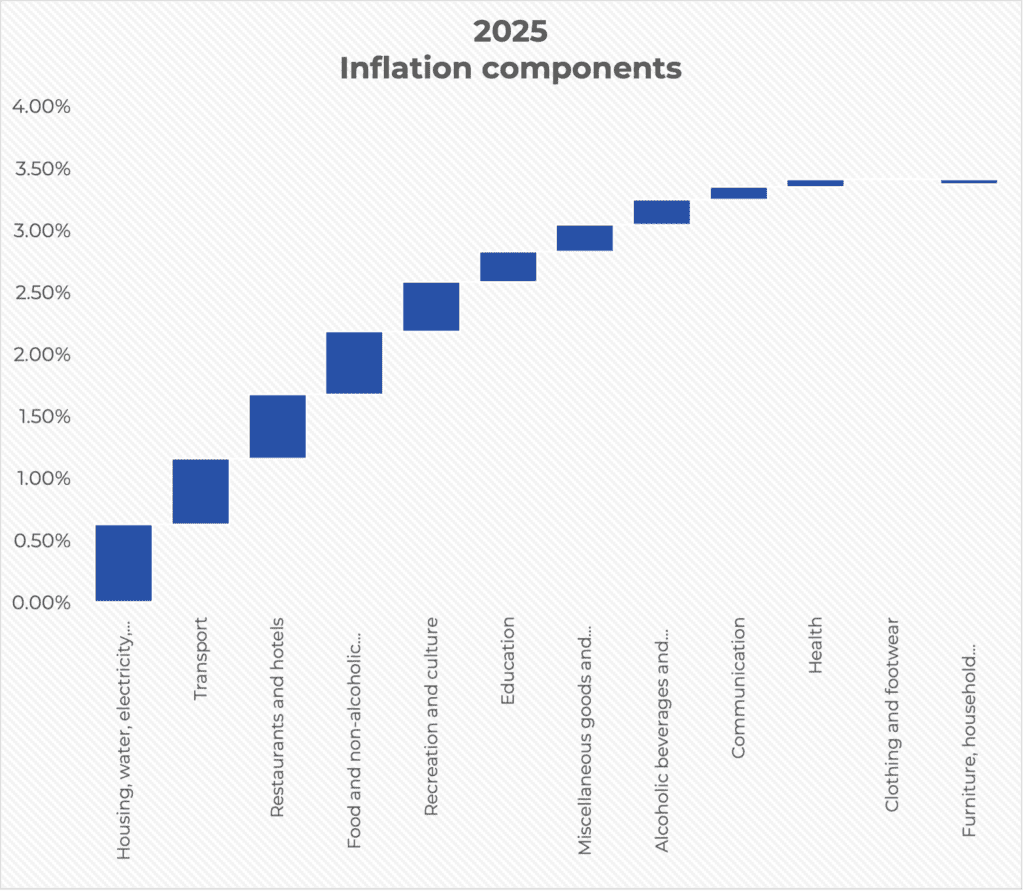
The waterfall chart above shows how the CPI’s twelve sectors contributed to 2025 inflation, allowing both for the sector’s underlying 2025 price rises and its weighting in the index. Weighting is important: the sector with the highest inflation was education at 7.6% (due to the introduction of VAT on private school fees), but it has only a weighting of 3.2%, so its overall impact was minimal.
On the other hand, ‘Housing, water, electricity, gas and other fuels category’ accounts for about one-eighth of the CPI ‘shopping basket’, so its 4.9% inflation made it the sector which contributed most to overall inflation. Only one sector, ‘Furniture, household equipment and maintenance’, which accounts for about 6% of the index, recorded an annual price fall of 0.6% across 2025.
Why inflation still matters for financial planning
In the six years since December 2019, the CPI has risen by 28.9%, compared with 23.3% across the whole of the previous decade. That is a reminder that inflation must always be part of any financial planning, even if, at times, it seems to have disappeared.


 Source: Office for National Statistics