Henson Crisp independent financial advisers in Peterborough and Cambridge

FREQUENTLY ASKED QUESTIONS

What are the UK’s main taxes?

The largest sources of UK tax revenue are typically income tax, National Insurance, VAT and corporation tax.

Why do income tax receipts rise when rates stay the same?

Receipts can rise because of frozen allowances and thresholds, wage growth, and more people moving into higher tax bands.

What is fiscal drag?

Fiscal drag occurs when tax thresholds do not rise in line with earnings or inflation, increasing the amount of tax paid without headline rates changing.

Could future Budgets include more tax changes?

Future Budgets may include further adjustments if the government needs to raise revenue while maintaining key manifesto commitments.
RISK WARNING
Tax treatment varies according to individual circumstances and is subject to change.

The Financial Conduct Authority does not regulate tax advice.
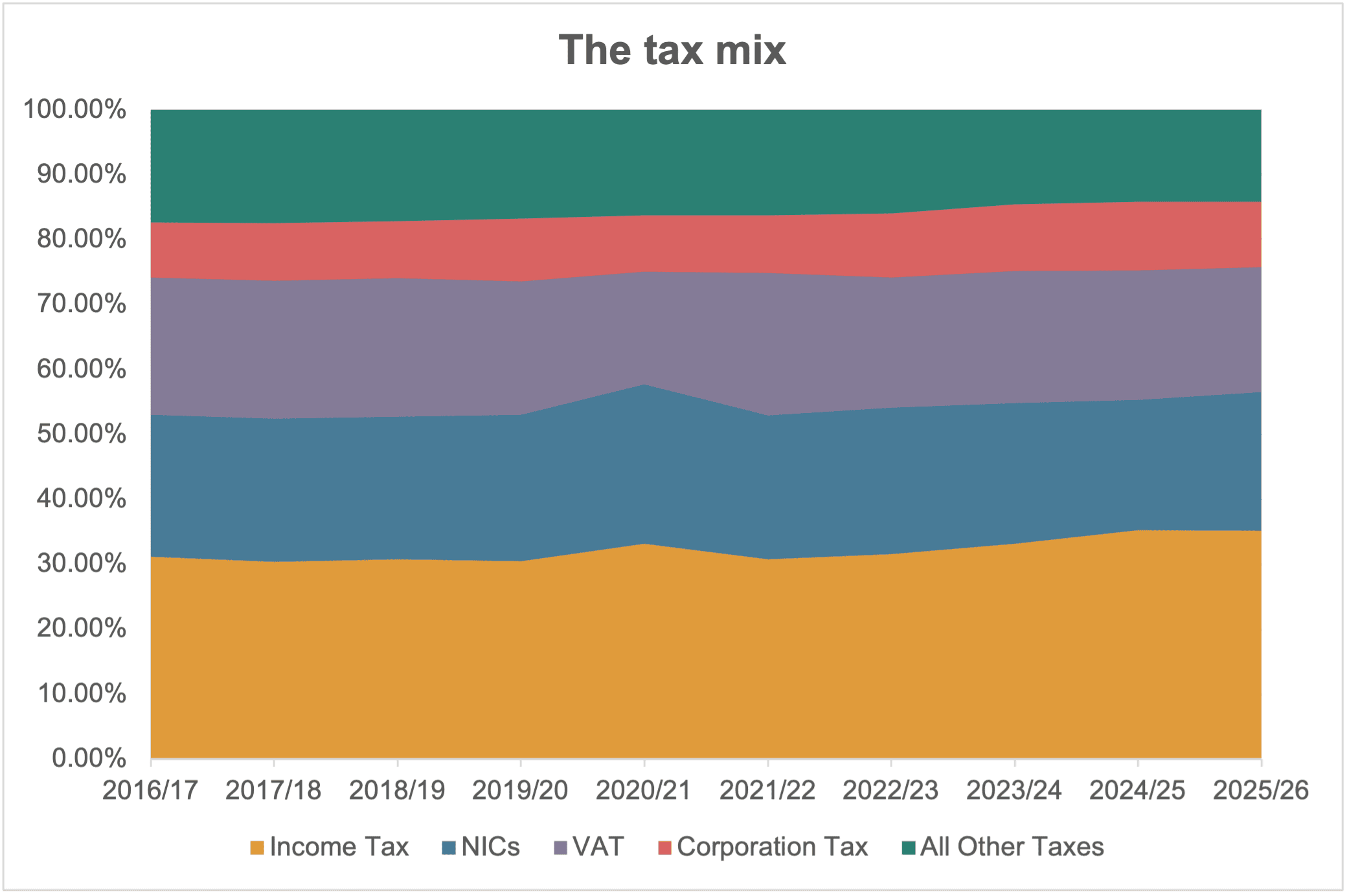
New data from HMRC shows how much the government relies on just four taxes.
Graph showing UK tax receipts
Source: HMRC

Labour and the UK tax reciepts

The Labour Party went into the 2024 general election with pledges on four major taxes in its manifesto:

• “Labour will not increase taxes on working people, which is why we will not increase National Insurance, the basic, higher, or additional rates of Income Tax, or VAT.”

• “Labour will cap corporation tax at the current level of 25 per cent, the lowest in the G7, for the entire parliament…”

At the time, the tax promises were seen as politically necessary to counter suggestions that a Keir Starmer government would operate tax-and-spend policies. However, the quadruple tax lock was widely criticised by many economists for the half decade constraint that it placed on the Chancellor in uncertain times.

The four taxes HMRC relies on most

Fast forward about two years from the publication of that manifesto, and the economists have been vindicated. New data from HMRC, published at the end of April, showed that in the past tax year, income tax, national insurance (NI), VAT and corporation tax accounted for 86% of all tax receipts. That is not surprising – as the graph shows, over the past ten years, the quartet account for more than £4 out of every £5 tax collected.

Why income tax receipts are rising

Despite the manifesto promise, income tax receipts rose by 9% in 2025/26 from the previous year – faster than the growth in prices or the UK economy. That outpacing is due to the freezing of the personal allowance and tax thresholds, dragging more people into tax and more existing taxpayers into higher tax bands.

NI receipts grew even faster – 16.3% up – thanks to the manifesto-challenging changes to the level of employer’s NI contributions. Together, NI and income tax – the two taxes on earnings – accounted for 56.5% of all that flowed into HMRC’s coffers.

The jumps in taxes on earnings contrasted with the growth in the third largest source of tax, VAT, which grew by 5.7%. Corporation tax had even slower growth (4.6%), but that might be because employers claimed more tax relief on those higher NI contributions.

What this could mean for future Budgets

The dominance of the big four manifesto-locked taxes explains why the Chancellor has made so many tweaks to the overall system to raise additional revenue. Be prepared: it is beginning to look like that process will be repeated at the next Budget.
READ THE LATEST HMRC TAX BULLETIN

FREQUENTLY ASKED QUESTIONS

What are the UK’s main taxes?

The largest sources of UK tax revenue are typically income tax, National Insurance, VAT and corporation tax.

Why do income tax receipts rise when rates stay the same?

Receipts can rise because of frozen allowances and thresholds, wage growth, and more people moving into higher tax bands.

What is fiscal drag?

Fiscal drag occurs when tax thresholds do not rise in line with earnings or inflation, increasing the amount of tax paid without headline rates changing.

Could future Budgets include more tax changes?

Future Budgets may include further adjustments if the government needs to raise revenue while maintaining key manifesto commitments.
RISK WARNING
Tax treatment varies according to individual circumstances and is subject to change.

The Financial Conduct Authority does not regulate tax advice.
GET IN TOUCH
Start your journey to financial freedom today.
Personal Finance Society Badge
Consumer Duty Alliance
Financial Vulnerability Charter Badge
Henson Crisp Limited

Telephone: 01733 355120

Email: enquiries@hensoncrisp.com

Henson Crisp Ltd is directly authorised and regulated by the Financial Conduct Authority, financial register number: 469175. Company is registered in England & Wales 06266686; (Registered office: Ground Floor, Bank House, The Lawns, Peterborough, Cambridgeshire, PE3 6AB).

Financial Advice for individuals and businesses
Site Disclaimers

No investment decision should be taken based on the content of this site. Always take full individual advice first.

Henson Crisp Limited cannot be held responsible for the accuracy of the content of external websites.

The information contained within this site is subject to the UK regulatory regime and is therefore targeted primarily at consumers based in the UK.

The Financial Ombudsman Service (FOS) is an agency arbitrating on unresolved complaints between regulated firms and their clients. Full details can be found on its website at www.financial-ombudsman.org.uk.
 © Henson Crisp Ltd. All rights reserved.
linkedin facebook pinterest youtube rss twitter instagram facebook-blank rss-blank linkedin-blank pinterest youtube twitter instagram